
Service by Running Hours, Not by the Date: Meters, Reading Reminders, and Inventory
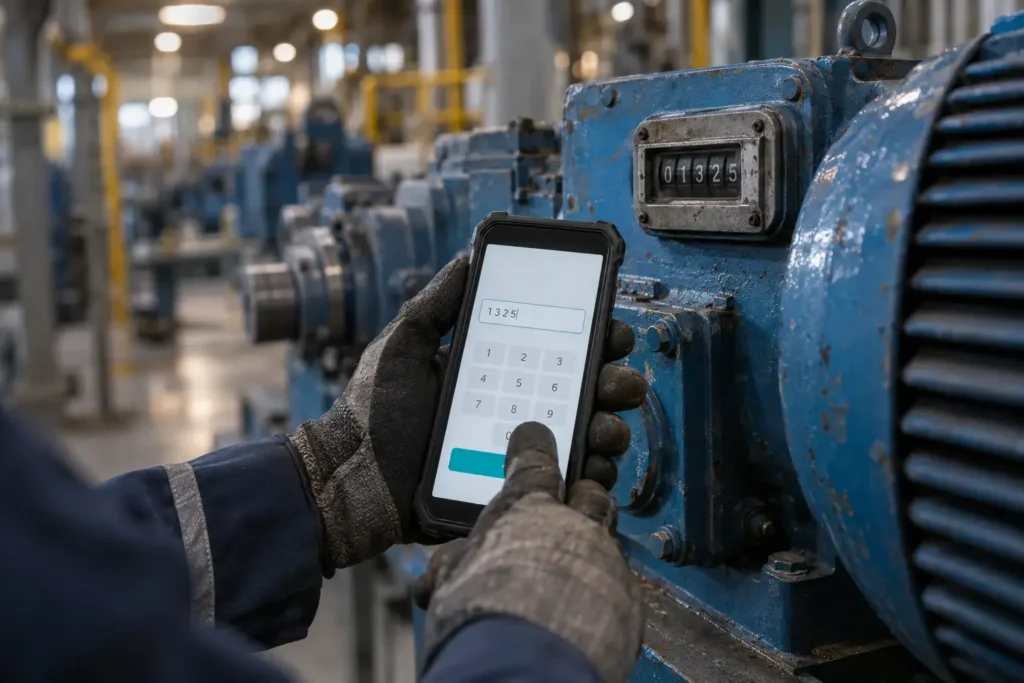
A monthly service on a compressor that ran 400 hours this month is late. The same monthly service on the one that ran 150 hours is early. The calendar cannot tell the difference, and for a long time neither could maintenance software. Three capabilities now live in Smart Maintenance Task Manager close that gap: maintenance driven by what a machine has actually done, reminders that keep the counters read, and stock that moves when the work is done.
Service by running hours, not by the date
A machine can now carry one or more meters: running hours, distance, cycles, or a custom unit of your own. A maintenance rule is then tied to the meter instead of the calendar — “service every 250 running hours” — and the system creates the task when the reading crosses the interval, not on a fixed day. Calendar schedules stay exactly where they were for everything that does wear by time.
The reading comes from the floor. Technicians record the counter from the phone while doing any task on that machine, offline, and it syncs like everything else — there is no separate visit to look at a dial and no clipboard to transcribe later. Planners see a projected next-due date for every rule, computed from how fast the meter is really moving, so the next service is visible before the reading gets there. A copied or moved machine keeps its meters, and a meter that has not been read for longer than its stale-after window is named in a daily digest to planners — a projection built on an old number is caught before it misleads a schedule.
The counter gets read, without nagging the crew
Usage-based intervals are only as good as the readings behind them, so each meter can carry a reading cadence — “read every 7 days”, optionally only on working days. If no assigned visit to that machine would naturally cover the reading, the system creates a small reading task for the technician on the phone. A reading given during any other task on that machine satisfies the window, so nobody is sent across the plant just to write down a number.
- Reading tasks appear in the technician’s inbox like any other task.
- Missed readings are reported to planners once per window — not nightly.
- If a technician keeps closing a reminder without a number, the reminders back off automatically. A crew that is being nagged learns to dismiss; this is built so that never starts.
Stock that moves when the work is done
Lubricants and consumables are the one part of maintenance that spreadsheets never keep straight, because the number changes on the floor and the spreadsheet lives in the office. The new Inventory module books consumption from the task itself: when a technician records the quantity used on a lubrication task, the stock balance moves. No separate data entry, no reconciliation at month end.
- Hold stock as one inventory for the whole company, or one per production site — your choice.
- Receipts, adjustments, and transfers between sites are all recorded.
- Every movement sits in an auditable ledger, and the balance can always be rebuilt from it.
- A low-stock alert fires when a balance crosses its reorder point, and re-arms after the next receipt.
Two things worth saying plainly. Inventory is an optional module that Pegotec enables per customer — everything else on this page is included in every subscription, and this is the one add-on. And it does not do purchasing: there are no purchase orders, order lists, or supplier records. It tracks what is on the shelf and what the work consumed, and tells you when to reorder.
Proven on a mining fleet, not just fixed plant
Meters were built for equipment that moves. A mining fleet register is now live on Smart Maintenance Task Manager with per-unit assets for haul trucks, excavators, loaders, and drills — each carrying its own hour, kilometre, and tonnage meters, each with staggered service rules. A fleet-wide average hides exactly the unit that is about to fail; forty trucks as forty assets, each with its own projected next-due date, shows it. That is why Mining now has its own page alongside manufacturing, food & beverage, textiles, chemical processing, automotive, and pharmaceutical.
Where to find it
Usage-based maintenance and reading reminders are described on the Scheduling page; the ledger, low-stock alerts, and the meter digests are on the Reporting page; and the Mobile App page covers recording readings in the field. To see any of it running against your own equipment list, book a demo.